
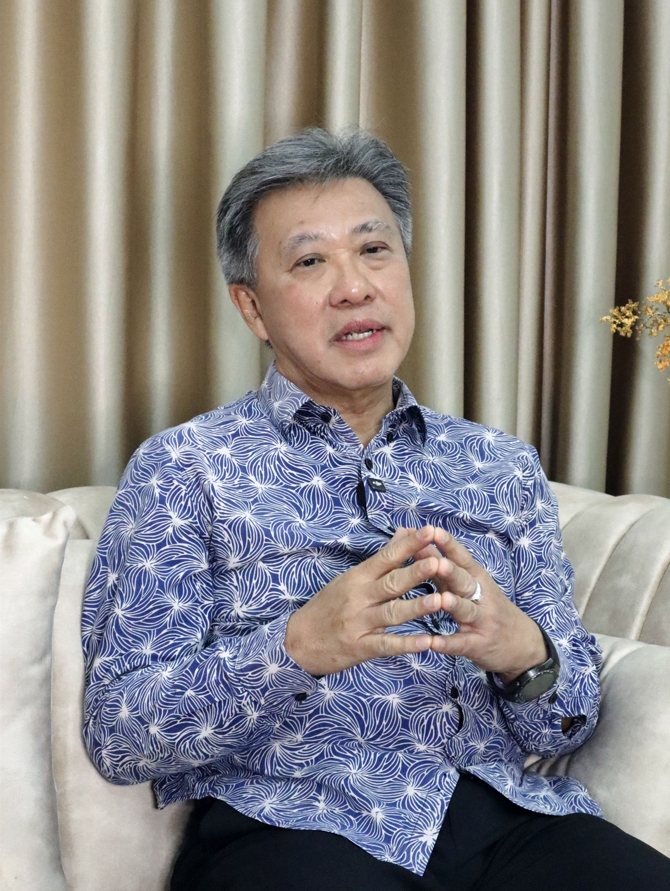
“10 million followers means nothing if you can’t generate value.” said Datuk Seri Wong Chun Wai
By TEE LIN SAY
linsaytee@suketv.com
14 May 2026, 5:00pm
KUALA LUMPUR: Traditional media agencies still have a place despite the rise of social media because they remain trusted and credible sources of information.
The credibility of content matters even more today, especially in an era where Artificial Intelligence and fake news are proliferating widely, says Bernama chairman Datuk Seri Wong Chun Wai.
Staying relevant and in the game, though, is where the challenge starts.
“People who are trained journalists, we go back to being a trusted brand. We are a trusted source of information,” says Wong, who has more than 40 years of experience in the media industry.
When it comes to news and content, Wong says it goes back to basics.
“You must have good content. The bottom line is that social media is just a platform. It’s a tool, and a useful tool no doubt, but you must have good content as the product,” says Wong.
He acknowledges that the way stories are told today has changed from, say, 20 years ago.
In the past, because mainstream media had a monopoly on news, these media outlets did not talk to nor engage with their readers.
“Back then, traditional media talked down to people. They told their readers what they should think and what they should read. But with social media today, that is all gone now,” he says.
Naturally, most content created today is shorter. The average attention span is very short because most people do not have time to read a long analytical report.
However short the content is, Wong says it should never interfere with the value and credibility of the information being presented. That is non-negotiable for a good journalist or content creator.
10 Million Followers Is Nothing If You Can’t Monetise It
Views, follows, and likes are important to a certain extent, but they are not everything.
This is more obvious when an influencer has millions of followers but generates zero income. At this point, the likes and follows are more of a “vanity metric”.
Wong cites the example of Malaysia’s premier weekly publication, ‘The Edge Malaysia’, which has a circulation of only about 30,000 copies but remains extremely profitable.
He says The Edge is an example of a media group that has done well without having the traditionally accepted high number of followers, such as in the millions.
A lot of this is down to its credibility and quality of content, which has rewarded The Edge with a targeted and entrenched following.
“Now if you're an influencer and you have 10 million followers, but this does not generate any revenue whatsoever, then so what?”
“The most these influencers can get is some companies selling cosmetics approaching them. But if I am a company selling properties, data centres, or land, I don't think I would want to use that sort of social media influencer,” says Wong.
He adds that it is the CEOs and entrepreneurs who decide how much advertising revenue they should allocate to a media company or social media platform.
“These people will still want to look at serious, quality stuff,” says Wong.
Social Media Can Get You Charged
Wong says that many content creators who are not professionally trained do not realise they are responsible for the comments posted on their portals or accounts.
It is a common sight nowadays to see many content creators standing in front of the camera, inciting hate and spreading toxic religious and political content.
“You can actually be charged. You can get into legal trouble because of your followers’ comments,” says Wong.
For example, someone posts very insightful or even ordinary content on Instagram.
Perhaps 100 people comment with all sorts of toxic, religious, and racially provocative remarks on that account. Many people do not realise that the account holder is responsible for all those toxic comments.
“Then somebody takes a screenshot of those comments while you're still asleep and then complains to MCMC (Malaysian Communications and Multimedia Commission) or whoever. You can be charged for this, okay?” says Wong.
So content creators aren’t just responsible for the information they put out, but also for the impact of that information.
Young People Don’t Read Enough
For anyone aspiring to be a journalist, Wong says you just need to read a lot.
“I'm old school, so I still read books. Social media does not give me that depth and time to think and reflect. Nowadays, people do not have the luxury to sit down and think anymore. This is why today’s generation struggles to think deeply,” he says.
Wong says good decisions are made after putting together various thoughts and calculations achieved through thinking and reflection.
Wong feels that this sort of reflection is missing in society today.
“I try to understand it in a better way because many are in situations where they need to put food on the table. People are struggling with their budgets, kids, and working long hours. I think most people just do not have the luxury to actually read and think,” he says.
For journalists, though, Wong says there are no excuses.
“You are expected to do that. You have decided to take up journalism and be a journalist, or whatever name you call it.
“You are trying to push your narrative and your content to people, and people are reading your stuff or watching your stuff. You really need to do your homework, talk to people, and understand people,” concludes Wong.

Web Edited by YAN PHENG LIANG
yanphengliang@suketv.com