
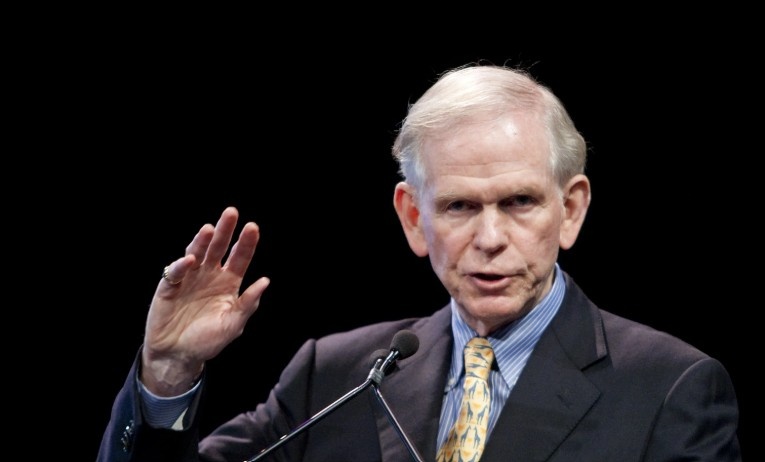
Jeremy Grantham
By TEE LIN SAY
linsaytee@suketv.com
28 June 2026, 4:30pm
- The AI bubble is the biggest in American history.
- If you currently own a large personal position in U.S. technology stocks, sell it all.
- If you are still holding SpaceX shares now... good luck.
- Cryptocurrency is a completely unnecessary piece of nonsense, apart from facilitating criminals moving money.
These are just some of the things said by British billionaire investor Jeremy Grantham in a revealing and insightful interview with Steven Bartlett on his podcast Diary of a CEO, released on June 26.
Grantham is the co-founder of GMO LLC, an institutional investment firm in Boston that managed US$118 billion at its peak in 2015.
He is the man who predicted the historic top of Japan in 1989, the dot-com crash in 2000, and the 2007 housing collapse.
Right now, Grantham believes a major correction in the U.S. market is extremely close.
The signs, he says, are clearly visible.
"I see what is quite possibly the most dangerous and historically expensive market in American history. People look at the major indices hitting all-time highs and they assume that strength means safety.
"It's a complete illusion. We are witnessing what I define as a 'super bubble'. A standard bubble is fairly straightforward—an isolated asset class becomes decoupled from economic reality.
"But a super bubble occurs when you have multiple major asset classes overvalued at the exact same time—housing, bonds and equities—all happening alongside extreme, unbridled investor euphoria," says Grantham.
Some people may argue that the high valuations we are seeing today are entirely justified because of the massive productivity boom promised by artificial intelligence (AI).
Having managed billions of dollars, Grantham says a fundamental truth about finance is that market psychology and human behaviour matter far more than pure mathematics.
During a manic phase, the maths goes completely out the window.
AI will absolutely change the world, but absurd valuations will trigger a crash
Is the AI wave both a technological revolution and another speculative bubble?
Grantham says it is both, and that's what makes it so deceptive.
He says that if you look back to late 2022, the broader stock market was actually starting to deflate quite normally. The air was coming out of the post-pandemic speculative frenzy.
"Then, almost overnight, ChatGPT was released, and it completely altered the trajectory. It acted like a booster rocket on a dying fire. It created what I call a bubble within a bubble," he says.
Despite that, Grantham says AI is indeed revolutionary and will absolutely change the world.
"We have seen this exact movie before. Look at the late 1990s and the internet boom. The internet did change everything, exactly as promised. It fundamentally transformed global commerce.
"However, in 1999, investors priced tech stocks as if that 20-year future of perfection was going to materialise in a single afternoon.
"When reality could not keep up with the absurd valuations, those tech stocks crashed 70% to 80%, even though the internet itself was a MASSIVE success.
"AI is on the exact same trajectory. The hype has completely detached from current corporate earnings," says Grantham.
What happens when this AI bubble bursts?
Grantham says that when the euphoria fades, the correction is going to be incredibly painful.
Right now, a tiny handful of elite tech giants—the companies driving the major indices—are carrying the entire market on their backs.
When the correction hits, be prepared to see these high-flyers experience price declines of 70% or more.
A crash like this will not be confined to Wall Street alone.
Grantham says that when these massive companies lose trillions of dollars in market capitalisation overnight, they immediately look to protect their margins by implementing massive corporate layoffs.
That triggers a brutal macroeconomic domino effect and creates a significant negative wealth effect.
"People will be significantly poorer, and so they stop spending. When consumer spending drops, corporate revenues across all sectors plummet, and soon we find ourselves entering a very deep, very painful recession," says Grantham.
SpaceX – An Indicator of the Impending Crash
A specific indicator that the U.S. market has reached the peak of investor euphoria is companies like SpaceX, says Grantham.
"It's a prime indicator of the crazy, speculative euphoria that defines a market top.
"SpaceX has gone out and practically defined its ultimate addressable market as 'a quarter of global GDP' (Gross Domestic Product), by pitching ideas like asteroid mining and space colonisation.
"It is a fabulous B.S. (bullshit) story. Coupled with the incredible hype surrounding AI, it's the classic textbook description of a market peak. It's exactly the kind of narrative you look for when a bubble is about to burst," he says.
What should the average person do?
If Grantham is correct, and the U.S. market is indeed that dangerous, how should the average person protect their money?
Grantham says Rule No. 1 is incredibly simple—get out of U.S. equities.
This is because the major U.S. stock indices are so heavily weighted towards these hyper-overvalued tech companies that the U.S. market carries an unprecedented amount of downside risk.
"You do not want to be holding the bag when the music stops," says Grantham.
He says investors should diversify globally and look for value where assets are actually priced reasonably.
If he were structuring a defensive, wealth-preserving portfolio today, it would look like this:
• 60% in non-U.S. equities: Look towards international stocks and emerging markets. They are historically much cheaper than U.S. stocks, carry significantly lower downside risk, and have recently outperformed because they are not bloated by AI hype.
• 5% to 10% in precious metals: Maintain a meaningful allocation in gold and silver. When systemic shocks hit the global financial system and fiat currencies come under stress, precious metals serve as an essential historical hedge.
• The remainder in bonds and cash: Real estate is incredibly expensive by historical standards, so Grantham would avoid buying property at these levels. Instead, allocate the remainder of your wealth to high-quality bonds and liquid cash. This preserves capital and provides the flexibility to purchase quality assets at substantial discounts after the crash.
Cryptocurrency Is Nonsense
Grantham says cryptocurrency is a completely unnecessary piece of nonsense whose only value is facilitating criminals moving money.
He says it is a purely speculative mechanism and an asset class built entirely on an article of faith.
From a fundamental investing standpoint, its intrinsic value is essentially nil.
Grantham says true investing requires an asset to actually produce something.
A stock gives you a claim on corporate earnings and dividends.
A bond pays interest.
Real estate generates rental income.
Even commodities such as oil and copper have genuine industrial utility.
Cryptocurrency generates absolutely nothing. It has no earnings, no dividends, and no underlying cash flow.
Hence, its price appreciation is entirely psychological.
It relies entirely on what economists call the "Greater Fool Theory".
"The only reason you buy Bitcoin at US$60,000 or US$70,000 is not because it produces a yield, but because you are betting that a greater fool will come along tomorrow and buy it from you for US$80,000.
"It thrives exclusively on faith and unbridled speculation," says Grantham.
When a market is flooded with historically high levels of liquidity—like we've seen over the last several years through central bank money creation—that money has to go somewhere.
It washes into the most speculative corners of the market.
Cryptocurrency, much like AI high-flyers or speculative technology stocks, is simply a giant thermometer measuring the sheer scale of investor mania.
When the broader financial system experiences a major liquidity squeeze and the super bubble bursts, these purely faith-based assets are typically hit the hardest because there is no fundamental floor to support them.
Grantham is fully dedicated to fighting climate change and environmental degradation via his philanthropic foundation, The Grantham Foundation for the Preservation of the Environment.
Close to 95% of his net wealth goes to his foundation for this exact purpose. He says accumulating billions just to sit on it is entirely meaningless for him.

Web Edited by YAN PHENG LIANG
yanphengliang@suketv.com